In 2009 we gave homeowners the same advice, over and over.
If you do not have to sell, do not sell. Rent it.
Prices were falling. Buyers had disappeared. A family that had to move for a job, or simply wanted to move, was looking at selling a home for far less than it was worth a few years earlier. Some had no choice. Many did.
A number of our clients took that advice. They kept the house, found a tenant, and moved on with their lives. It turned out to be one of the wiser financial decisions they ever made.
Here is why.
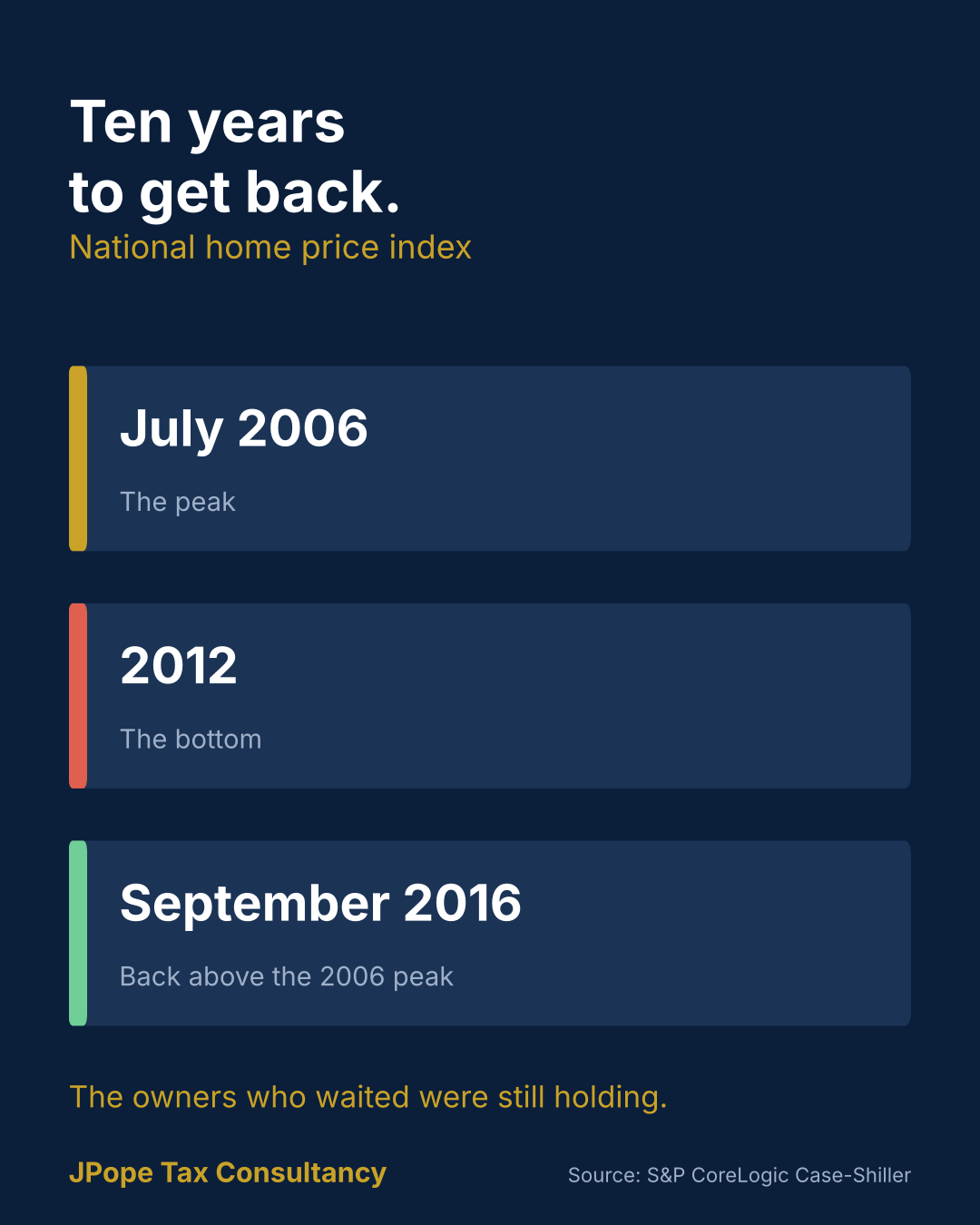
Home prices across the country peaked in July 2006. They did not hit bottom until 2012. An owner who sold in 2009 locked in the loss for good. There was no getting it back.
The owners who rented instead had three things working for them.
Rent came in every month. It covered most, sometimes all, of the payment.
Depreciation gave them a deduction every year. A rental home is depreciated over 27.5 years. The building, not the land. That deduction often sheltered much of the rent from tax.
And they had time. Time was the asset.
In September 2016, the national home price index finally passed its July 2006 peak. Ten years. The owners who waited were still holding the house when it got there.
A historical perspective
A decade of holding time
U.S. National Home Price Index · as reported in November 2016
July 2006
The prior peak
The national index reaches its pre-crisis high.
2009
The owner’s decision
Sell now, or hold the home and rent it.
2012
The low point
The national index reaches its post-crisis low.
September 2016
Back above the peak
The national index passes its July 2006 level.
Not seasonally adjusted. Historical milestones; later data revisions can change the recovery date.
Source: S&P’s November 29, 2016 release
Today is not 2009. We do not believe the financial crisis is coming back, and we do not believe real estate is about to collapse. Most owners today have low mortgage rates and plenty of equity.
But some of the same dynamics are back. In many markets homes sit. Sellers now outnumber buyers nationally by the widest margin in the records, which go back to 2013. It is harder to sell a home today than it was a year or two ago. Owners who have to move are facing the same choice our clients faced in 2009.
So the old advice still works.
Rent it. One rule to know before you do. When a home becomes a rental, it is depreciated on the lower of what you paid for it, plus improvements, or what it is worth the day it becomes a rental. A home that has doubled in value is still depreciated on what you paid. You cannot buy a house for $350,000, watch it climb to $700,000, and depreciate $700,000.

There is also a clock to watch. If you lived in the home two of the last five years, you can still exclude up to $250,000 of gain when you sell, or $500,000 for a married couple. Rent it out and sell within about three years of moving out, and that exclusion can still apply.
And there is recapture. Depreciation comes with recapture tax when you sell. Whether keeping and reinvesting those tax savings beats paying the recapture is a math problem. Run the math before you decide.
If you would rather rent the home a few nights at a time to travelers, the rules change again. Short-term rentals can produce deductions that offset other income, if the average guest stays seven days or less and the owner is actively running it. Those rules are specific, and they are worth a conversation before the first guest arrives.
The advice was simple in 2009. It is simple now.
Do not sell below your price unless you have to. Plan the tax first.
This is general information, not tax advice for your situation. More at jamiepope.com.