We love 1031 exchanges. But they do not always serve the owner.
And right now, some of them cannot close.
The rules have not changed. An owner sells a building and, instead of paying tax on the gain, rolls the proceeds into another property. The tax is deferred. But the clock starts the day the first building closes. The owner has 45 days to name the replacement property and 180 days to close on it. Miss either one, and the sale becomes taxable.
The 1031 exchange timeline
Two clocks. One starting point.
Transferring the relinquished property starts both periods. The 180-day period includes the first 45 days.
The receipt deadline is the earlier of: day 180 or the due date of your tax return for the transfer year, including extensions.
- Day 0Transfer
The relinquished property closes; both clocks begin.
- Day 45Identify in writing
Written identification of replacement property is due.
- Day 180*Receive property
Receipt is due, subject to the earlier tax-return deadline above.
Nominal day 180 endpoint. Receipt was due by today, or by an earlier tax-return due date, including extensions.
* Nominal calendar-day diagram; actual dates are transaction-specific. This illustrates deadlines, not access to exchange funds. Source: IRS, Instructions for Form 8824 (Deferred Exchanges; Lines 5 and 6).
In 2009 and 2010 we watched exchange after exchange run into the same wall. The owner sold at one price. Then the owner went looking for a replacement and could not find one that made the exchange work. Nothing worth buying, at the right price, inside the deadline.
That is happening again.
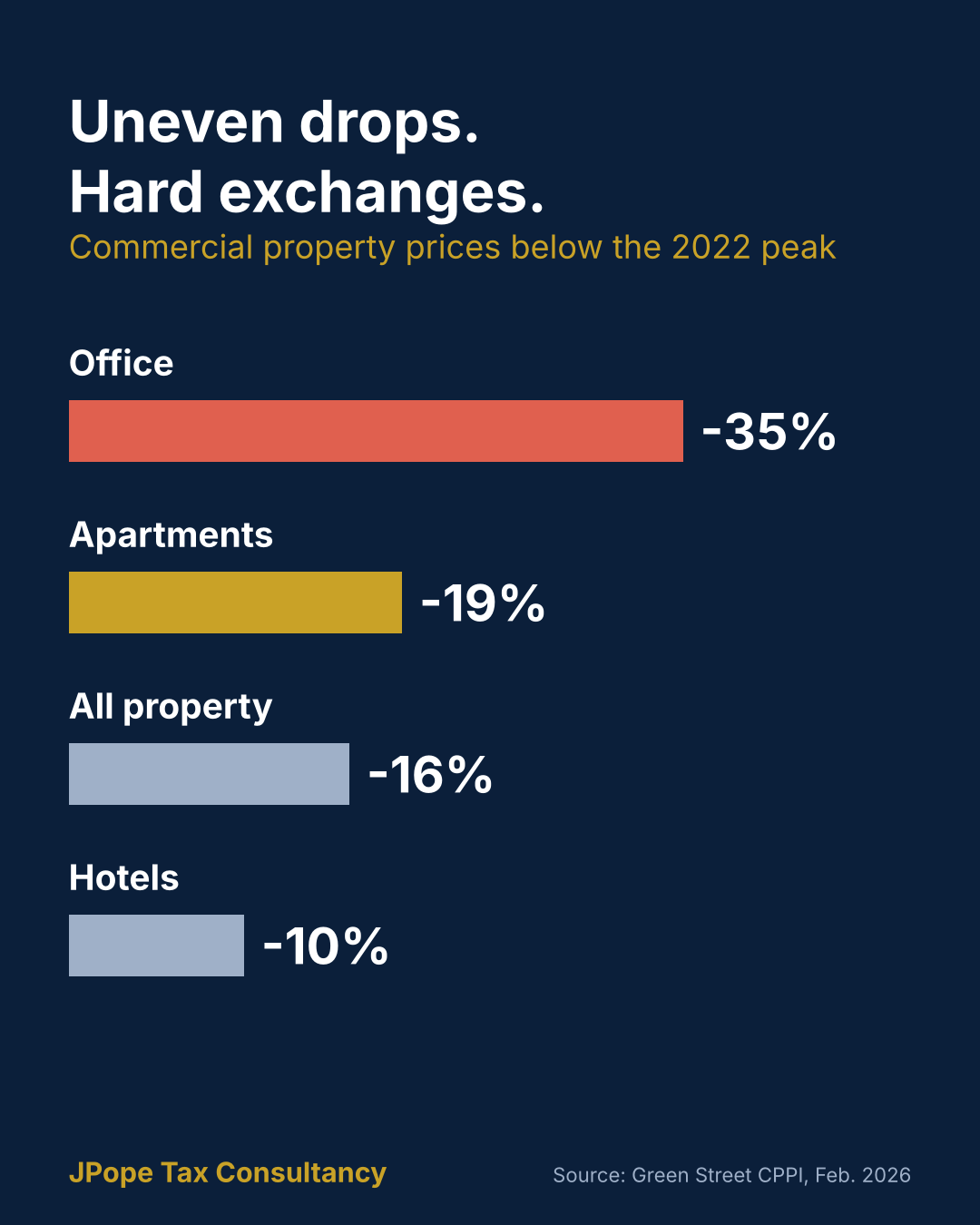
Commercial property prices have not fallen evenly. A widely followed commercial property price index showed office values 35% below their 2022 peak earlier this year. Apartments were 19% below. Hotels, 10%. Across all property types, 16%.
When values fall unevenly, matching a sale to a replacement gets hard. The office owner who finally finds a buyer cannot find a replacement worth as much that he wants to own. The apartment owner in a soft market sells for less than he hoped and cannot find a property in another market at a price that pencils.
So he trades down.
Trading down has a cost. Sell a building for $5 million, buy the replacement for $4 million, and the $1 million difference is taxable. Pay off a $3 million loan on the old building and take on only $2 million on the new one, and that $1 million drop in debt can be taxable too.
The numbers behind a trade down
Two gaps to calculate.
The purchase price and the replacement debt each belong in the exchange analysis.
Property value
Sell
$5million
Buy
$4million
$1 milliondifference in property value
Debt
Pay off
$3million
Replace with
$2million
$1 millionreduction in debt
Calculate the net taxable amount.
These are separate comparisons, not two amounts to add together. Cash paid, liabilities assumed and exchange expenses can affect the result. Gain recognized cannot exceed the gain realized.
And sometimes the exchange is the wrong tool altogether.
If the building sold for less than the owner paid, an exchange does not just defer a gain. It defers the loss. A loss on business real estate can often offset other income. An owner who exchanges into another building gives that up, at least for now. Sometimes the better answer is a straight sale.
Run it both ways
Compare the exchange
with a straight sale.
Start with the tax position. Then decide whether the replacement property serves the owner.
Calculate gain or loss
using adjusted tax basis.
A gain to defer
Test the exchange.
- Does the replacement fit the owner’s plan?
- Can identification and closing meet the deadlines?
- How much gain would still be recognized?
Defer qualifying gain.
Carry tax basis forward.
A loss to recognize
Test a taxable sale.
- Is there a tax loss after basis adjustments?
- Can the loss be used under the applicable rules?
- Would a full disposition release passive losses?
Recognize an eligible loss.
Avoid carrying it into an exchange.
There are other doors.
An installment sale spreads the gain over the years the buyer pays. An Opportunity Zone investment can defer the gain and, held long enough, shelter the growth on the new investment. A taxable sale can release rental losses the owner has been carrying for years and could never use. And if the exchange fails because no replacement was found, the gain may still be reported in the year the money is released, if the exchange was set up properly and started in good faith.
Each one is a math problem. None of them is automatic.
This is not 2009. Most of the market is not in crisis. But in office, and increasingly in hotels and apartments, the inability to move a property is starting to sting. The owners who come through it best will be the ones who ran the numbers before they listed.
Run the exchange both ways. Then decide.
This is general information, not tax advice for your situation. More at jamiepope.com.